Measuring your coin
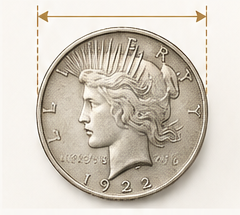
Diameter
Measure the widest point across the face of the coin, in millimetres.
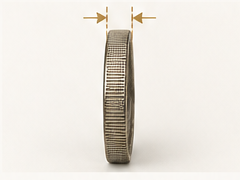
Thickness
Measure the coin from one face to the other while it is standing on its edge, in millimetres.
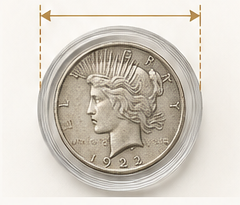
Coins in capsules
If the coin sits in a capsule, measure the outer diameter and the total thickness of the closed capsule.
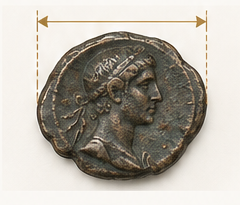
Ancient or irregular coins
Measure the largest diameter and the thickest point. If the shape is unusual, add a photo during checkout.
Returns and refunds
You have 14 days from delivery to withdraw from most catalogue orders, unless the display was printed to coin measurements you supplied or is a custom design. You pay return postage unless the item was damaged, faulty, or not as described.
Full terms, the model form, and the electronic withdrawal form: Shipping & returns and Withdraw from contract here.
Reviews
All reviews are from customers who placed a paid order with us on this website or in our Etsy shop. We check each review against the order record before publishing it. We do not pay for reviews or offer anything in return, and we do not delete negative ones.
Looking after your display
Dust it with a dry or barely damp cloth. Avoid solvents and household cleaners. PLA softens above 50 °C, so keep the piece out of a closed car in summer and out of long direct sunlight on a south-facing windowsill. Indoors on a shelf or desk it is stable long-term. If possible place moisture-absorbing packets in your display or acquire a humidity-stable display case.
FAQ
Can you make something custom?
Yes. Send a request through the custom designs form and we will confirm the design, price and lead time before you pay.
Which size should I choose?
These ranges give a good aspect ratio between the coin and the figurine:
| Your coin diameter | Choose |
|---|---|
| Up to 20 mm | 10 cm |
| 20 mm to 30 mm | 14 cm |
| Above 30 mm | 17 cm |
| Also on every listing | 21, 25 or 30 cm |
Going bigger always comes with better quality of the details, so if you have the desk or display space we recommend getting the bigger variants.
Still unsure? Email us the coin type and we will tell you which size we would send. We would rather answer than have you guess.
How long will delivery take?
Every piece is printed for your order, which takes 1 to 3 days. Transit begins after dispatch.
| Destination | Transit after dispatch | Usually arrives within |
|---|---|---|
| Netherlands | 1–2 working days | 2–5 days |
| Belgium, Germany | 1–3 working days | 2–6 days |
| Rest of the EU | 2–6 working days | 3–9 days |
| United Kingdom | 3–6 working days | 4–9 days |
| United States | 6–8 working days | 7–11 days |
| Canada | 4–9 working days | 5–12 days |
| Australia | 6–8 working days | 7–11 days |
These are averages, not guarantees. Customs processing, public holidays and carrier delays can extend them.
Who delivers my order?
We ship from the Netherlands with PostNL. Once the parcel reaches your country it is handed to your national postal service and delivered with your normal mail (USPS in the United States, Canada Post in Canada, Royal Mail in the United Kingdom, Australia Post in Australia, Deutsche Post or DHL in Germany, and the national post elsewhere). There is no courier appointment, no depot collection and no broker involved.
Your tracking number works on both the PostNL site and your local postal service's site. Tracking often shows no movement for several days while the parcel is in transit between countries and during the handover. This is normal and does not mean anything is wrong.
Will I pay customs or import fees?
United States
US import tariffs already paid. We pay them before your parcel leaves the Netherlands, so nothing is collected on delivery.
Canada
Canadian import charges are not included. Canada Post collects duty, GST or HST and a small handling fee from you when the parcel is delivered. This applies to almost all orders from outside Canada.
United Kingdom
Prices exclude UK import VAT and any carrier customs handling charges. UK VAT is collected by the UK delivery carrier before or at delivery. This applies to England, Scotland and Wales. We do not ship to Northern Ireland at the moment. UK orders need at least £175 in items, after any discount.
Australia
For Australian orders under AUD 1,000, import duties or GST are not normally payable on delivery; any exceptional customs charges remain the buyer’s responsibility.
European Union and the Netherlands
No customs charges. Your order ships inside the EU, so there is nothing to pay on delivery and no customs paperwork.
Is it safe for my coins?
Short answer: yes, in normal display conditions, and we looked into this properly rather than assuming it.
Every display is printed in PLA, a rigid plant-based plastic. It contains no PVC and no plasticisers, which are the substances that damage coins in old flips and albums. Your coin rests in the recess under its own weight: no glue, no clamp, nothing adhesive touching the surface, and you can lift it out whenever you like.
What the research says
The concern with any plastic kept near metal is not the plastic itself but what it slowly releases into the air around it. Conservators test for this with the Oddy test, the method developed at the British Museum to decide whether a material is safe to place next to a museum object. Coupons of silver, lead and copper are sealed in a container with the material for 28 days at 60 °C and 100% humidity, then examined for corrosion.
A 2021 study in the Rapid Prototyping Journal ran that test on eight printed filaments (including white PLA, natural PLA and PETG) to establish whether they were suitable for restoring fragile archaeological objects. No significant change was found on any of the silver, lead or copper coupons, and the authors concluded the materials were suitable for conservation work with long-term stability.
Two things are worth knowing about that test. It is deliberately harsher than real life: a sealed container at 60 °C and total humidity is a worst case, not a shelf in a living room. And it tested printed parts rather than raw filament, which matters, because the two behave differently.
We also looked for evidence that PETG would do better than PLA and found none. The study above tested both and found both suitable. Both materials absorb moisture and both release small amounts of gas. What appears to matter more than the choice between them is how few additives the filament contains, and we buy accordingly.
What we have found ourselves
We have tested our displays with our own coins to the best of our ability and have observed no damage, discolouration or residue.
Our practical advice
Keep the display in open air rather than sealed inside an airtight case or box. Although research suggests the material is safe for display use, this adds an extra layer of safety. On an open shelf or in a ventilated cabinet there is nothing to accumulate.
If a coin is especially valuable or sensitive and you would like to be extra careful, order the version made to hold a capsule, place your coin in a capsule, and then set the capsule on the holder. That keeps the coin from contact with the printed surface.
Source: Aura-Castro, E., Díaz-Marín, C., Mas-Barberà, X., Sánchez, M. and Vendrell Vidal, E. (2021), "Characterization of 3D printing filaments applied in restoration of sensitive archaeological objects using rapid prototyping", Rapid Prototyping Journal, Vol. 27 No. 4, pp. 645-657. https://doi.org/10.1108/RPJ-06-2019-0153